



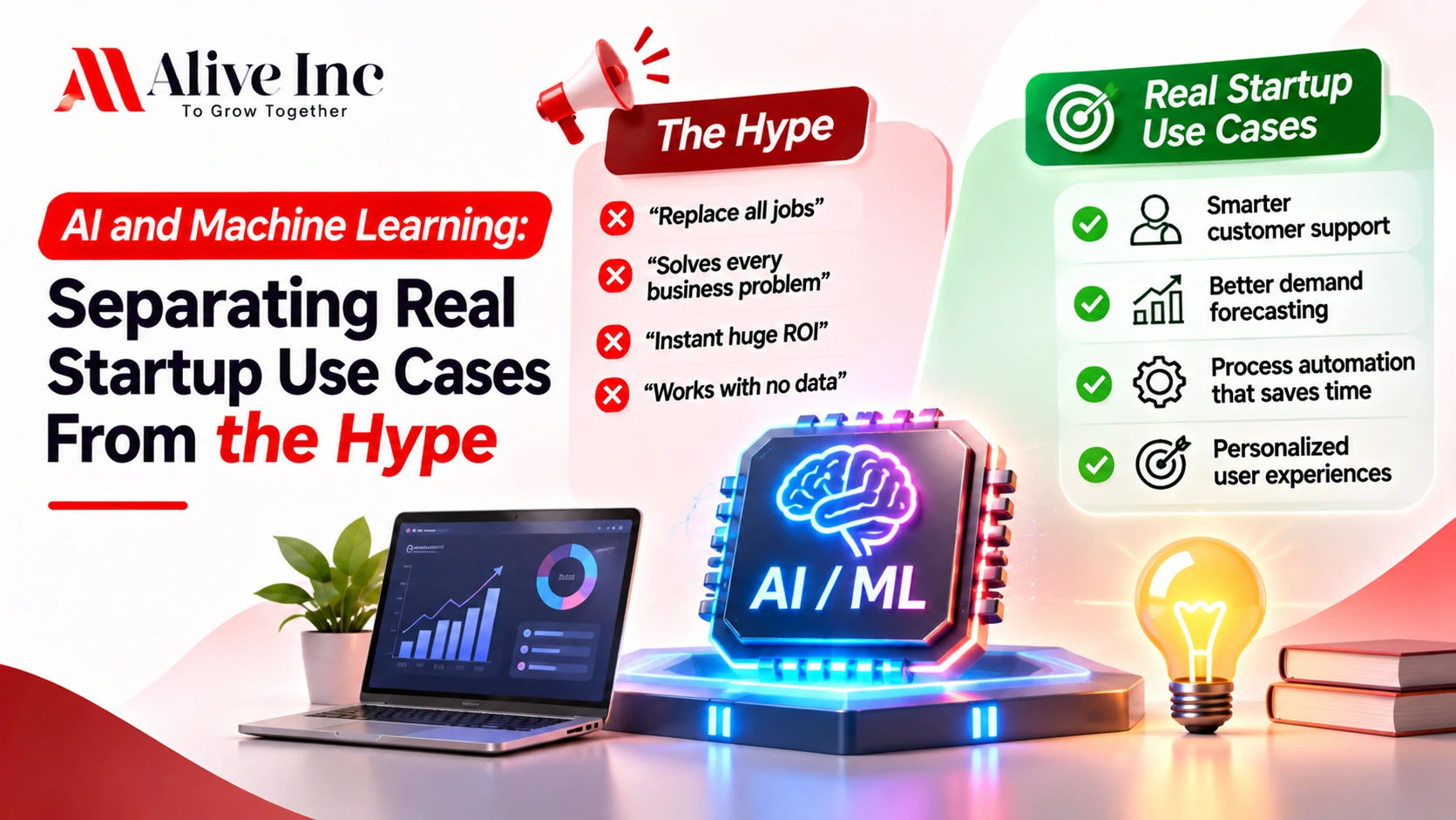
Artificial Intelligence (AI) is becoming a common part of startup strategies across industries. Almost every pitch deck mentions AI, but adopting it simply because it is trending does not guarantee business growth.
The more useful question is: which repetitive, data-heavy, or time-consuming business problem can AI actually solve?
Startups that approach AI with a clear business objective are more likely to see measurable benefits. Instead of building complicated AI products from the beginning, they can focus on specific improvements that reduce operational costs, improve customer experiences, and help teams make better decisions.
Here are some practical AI and machine learning applications that startups can implement to create real business value.
1. Customer Support and Lead Qualification
Customer support is one of the most accessible areas where startups can introduce AI.
As a business grows, support teams receive repetitive questions about order status, pricing, account access, product features, and basic troubleshooting. Handling every query manually consumes valuable time that could be spent solving more complex customer problems.
AI-powered chatbots and automated response systems can manage many of these routine interactions. They can provide instant answers, guide users through common processes, and direct more complicated requests to human support agents.
For lead-generation businesses, AI can also improve how sales teams prioritize potential customers.
AI-based lead scoring can analyze information such as customer interests, previous interactions, website activity, and enquiry details to identify prospects with a higher likelihood of converting.
This helps sales teams focus their efforts instead of treating every incoming lead equally.
2. Personalization at a Scale Humans Cannot Match
Personalization is another practical application of machine learning, particularly for businesses that serve large numbers of customers.
Traditional marketing often presents similar products, services, or content to every visitor. However, customers have different interests, purchasing patterns, and preferences.
AI-powered recommendation engines can analyze user behaviour and suggest relevant products, services, or content.
Common applications include:
- E-commerce product recommendations based on browsing and purchase history.
- Personalized learning recommendations in EdTech platforms.
- Content suggestions based on viewing or reading behaviour.
- Personalized marketing campaigns based on customer interests.
- Dynamic pricing based on demand and business rules.
For example, an e-commerce startup can recommend products based on a customer's previous purchases and browsing activity.
As more relevant user data becomes available, recommendation systems can improve their predictions. This creates opportunities to increase customer engagement, repeat purchases, and average order value.
However, personalization should respect customer privacy and applicable data protection requirements.
3. Operational Efficiency Beyond Customer-Facing Features
AI is not limited to chatbots and recommendation systems. Some of its most valuable applications happen behind the scenes.
Startups can use machine learning and automation to reduce repetitive operational work and improve decision-making.
Demand forecasting
Retail and inventory-based businesses can analyze historical sales, seasonal patterns, and demand trends to estimate future inventory requirements. Better forecasting can help reduce stock shortages and unnecessary overstocking.
Fraud and anomaly detection
Fintech and payment startups can use machine learning models to identify unusual transaction patterns, suspicious account activity, and potentially fraudulent behaviour. These systems can flag transactions for further investigation and help teams respond faster.
Document and data processing
AI-powered document processing can extract information from invoices, application forms, contracts, and other documents. Instead of manually entering every detail, employees can review extracted information and correct errors when necessary.
These applications are particularly useful for startups handling large volumes of operational data with limited resources.
4. What Does Adding AI Actually Require?
Implementing AI does not necessarily mean building a custom model from scratch.
Many startups can begin by integrating existing AI and machine learning services into their applications. These services provide capabilities such as text generation, document extraction, image recognition, classification, and predictive analysis.
For an early-stage business, this approach can reduce development time, infrastructure costs, and implementation complexity.
A practical implementation process includes:
- Identify a specific business problem that can be measured.
- Evaluate whether AI is genuinely suitable for solving it.
- Review the availability and quality of relevant data.
- Select an existing AI service or model that fits the requirement.
- Integrate it into the existing business workflow.
- Measure its accuracy, cost, and impact on operations.
Custom model development becomes more attractive when a startup has sufficient proprietary data and a clear reason why existing models or services cannot meet its requirements.
The decision should be based on business value rather than technical complexity.
5. Understand the Realistic Limitations of AI
AI can improve business operations, but it is not a solution to every problem.
The quality of an AI system depends heavily on the quality of the information used to train or operate it. Inconsistent, incomplete, or outdated data can produce unreliable results.
Startups should also consider several practical limitations:
- Data quality: Poor-quality information can reduce model accuracy.
- Implementation costs: API usage, infrastructure, integration, and maintenance require ongoing budgets.
- Privacy and security: Customer information must be handled responsibly.
- Model performance: Accuracy can change as customer behaviour and business conditions evolve.
- Human oversight: Important decisions may still require human review and accountability.
AI systems should be monitored after deployment. Regular testing helps identify performance issues, unexpected outputs, and changes in real-world data patterns.
The objective is not to remove human involvement entirely. It is to make existing teams more efficient and support better decisions.
6. Start Small, Measure Results, and Expand
One of the biggest mistakes startups make is trying to introduce AI into every department at once.
A better approach is to select one clearly defined problem and build a focused solution around it.
For example, a startup receiving hundreds of customer enquiries each month could begin with an AI-powered support assistant. Another business struggling with inventory planning could test demand forecasting using its existing sales records.
Before implementation, define measurable outcomes such as reduced response time, fewer manual processing hours, improved lead conversion, or lower inventory costs.
Once the solution demonstrates measurable value, the business can consider expanding AI adoption into other workflows.
This approach limits unnecessary investment and allows startups to learn from actual results.
Frequently Asked Questions
Do startups need their own data science team to use AI?
Not necessarily. Many practical AI features can be implemented using existing AI APIs and third-party services. An in-house data science team becomes more valuable when custom models or advanced data analysis offer a clear business advantage.
What is a realistic first AI feature for an early-stage startup?
A focused solution such as a customer support chatbot, lead-scoring system, or product recommendation feature is a practical starting point. Choose something connected to an existing business problem with measurable results.
How much data does a startup need before using AI?
It depends on the application. Pre-trained models and third-party AI services can work with limited proprietary data, while custom predictive models generally require sufficient relevant and consistent historical data.
Is AI implementation expensive for a small business?
It does not have to be. Integrating existing AI APIs for specific features can be more affordable than developing custom models and infrastructure. Startups can test the business value before making larger investments.
Conclusion
AI and machine learning offer startups opportunities to improve customer support, personalize experiences, automate operations, and make better business decisions.
However, successful implementation starts with identifying the right problem, not choosing the most advanced technology.
Startups should focus on practical applications, reliable data, measurable outcomes, and ongoing performance monitoring. By starting with focused use cases and expanding based on proven results, businesses can make AI a valuable part of their growth strategy rather than just another item in their pitch deck.